


Each year, the CDOT Office of Financial Management and Budget (OFMB) prepares a forecast of expected revenues in the Highway Users Tax Fund (HUTF) for upcoming years. CCI and CML use these HUTF forecasts, along with updated information from CDOT and the Department of Revenue on lane miles, bridge deck area, and vehicle registrations, to help local governments develop their annual road and bridge budgets. County estimates are available at the link below. Please remember that these are only estimates based on the Colorado Department of Transportation’s calculations.
To access/download the full materials, click the links below.
Materials
- Read the full memo here (opens new window)
- View full county estimates spreadsheet here (downloads .xlsx file)
The memorandum is also pasted below.
Summary
County HUTF revenue is still growing, but more slowly than CDOT projected a year ago. Total HUTF came in at $1.296 billion in FY 2025-26, short of the $1.318 billion CDOT forecast last fall. CDOT now expects total HUTF to reach $1.324 billion in FY 2026-27 and $1.431 billion by FY 2028-29. The county distribution was $246.8 million in FY 2025-26 and is projected to grow to $250.6 million in FY 2026-27, $257.2 million in FY 2027-28, and $263.3 million in FY 2028-29. That is growth of about 1.5 to 2.6 percent per year.
These figures are for the state fiscal year, which runs from July 1 through June 30. The estimates in the attached spreadsheet use an average of FY 2026-27 and FY 2027-28 to approximate calendar year 2027, which works out to about $253.9 million for all counties statewide. That is essentially flat compared to the calendar year 2026 estimate we shared last year ($254.2 million), so please plan accordingly.
Every year of the county forecast is also lower than it was last October. The FY 2026-27 county projection dropped by $6.6 million, and FY 2027-28 dropped by $9.2 million. Looking further out, CDOT projects county distributions will level off after FY 2028-29 and stay around $263 million through FY 2031-32.
What is driving the change
HUTF is a mix of fuel taxes, registration fees, FASTER fees, the road usage fee, and the retail delivery fee. This year, CDOT lowered its expectations for three of those: motor fuel taxes, vehicle registration fees, and vehicle rental fees.
Fuel tax revenue came in at $625.1 million in FY 2025-26, below the $633 million to $640 million that CDOT, the Governor’s Office of State Planning and Budgeting, and Legislative Council Staff all projected in June. Gasoline consumption in Colorado has been declining since 2023 as vehicles become more fuel efficient and more electric vehicles are on the road. Because the fuel tax is a flat amount per gallon, higher gas prices do not bring in more revenue, but they do lead people to buy less fuel. CDOT expects fuel tax revenue to hold at about $625 million through FY 2027-28 and then begin a slow decline.
EV adoption slowed significantly after the federal EV tax incentives were repealed, and CDOT has pulled back its expectations for EV growth over the next five years. The state’s ability to enforce the Colorado Clean Car standards will also depend on the outcome of a multi-state lawsuit over California’s Clean Air Act waivers. CDOT expects slower EV growth and the fuel tax to largely offset each other, with less EV fee revenue but more fuel tax and road usage fee revenue than it would otherwise see.
Vehicle rentals are down too. The number of rentals subject to the FASTER daily rental fee dropped in FY 2025-26, and Denver International Airport accounts for roughly half of all rentals in the state, so this revenue rises and falls with tourism. CDOT has trimmed its rental expectations for the next two years and is working on an analysis to refine that forecast.
The road usage fee and registration fees continue to grow by design. CDOT projects road usage fee revenue to rise from $159.1 million in FY 2025-26 to $230.3 million in FY 2028-29, and registration fees to rise from $245.4 million to $267.8 million over the same period. The chart below shows fuel tax holding flat while the other sources grow.
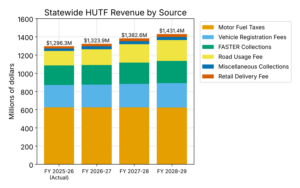
Source: CDOT Office of Financial Management and Budget, September 2026 forecast
Why off-the-top matters
Off-the-top appropriations, which primarily fund the Department of Public Safety, come out of first stream revenue before any formula distributions are made, and they can grow by up to 6 percent each year. CDOT projects off-the-top appropriations to grow from $221.4 million in FY 2025-26 to $264.1 million in FY 2028-29, which is faster than the fund as a whole. By FY 2028-29, off-the-top appropriations are projected to be larger than the entire county distribution.
You can see the impact in the county first stream numbers. County first stream revenue drops from $44.3 million in FY 2025-26 to $36.0 million in FY 2028-29, and CDOT projects it will fall to $22.9 million by FY 2031-32. When the top grows faster than the fund, it squeezes the amounts that flow to local governments.
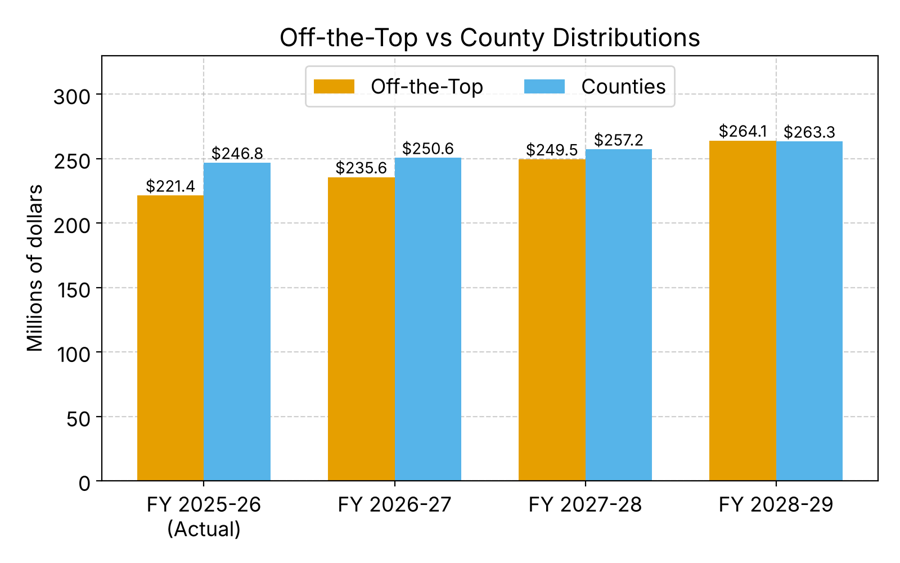
Source: CDOT Office of Financial Management and Budget, September 2026 forecast
Recent legislation shaping revenue
SB21-260 created the road usage fee on fuel, electric vehicle registration equalization fees, and the retail delivery fee, among other fees that are not distributed to the HUTF. A portion of retail delivery fee revenue flows to the HUTF and is then split among CDOT, counties, and municipalities as outlined in statute. Counties receive 33 percent of this revenue. CDOT is also finalizing a report required by SB21-260 on how these fees have been used and whether EV and gas vehicle fees are at parity. That report is expected in early October, and the preliminary finding is that EVs will pay more than their fair share as their fees increase. We expect it to be part of the 2027 conversation.
SB25-258 temporarily reduces the FASTER Road Safety Surcharge and, from September 2025 through September 2027, temporarily shifts the FASTER split to 54 percent CDOT, 24 percent counties, and 20 percent municipalities. This temporary shift is meant to hold local governments harmless. CDOT’s forecast shows FASTER revenue staying flat at $214.2 million in FY 2026-27 and then climbing to $234.1 million in FY 2027-28 as the temporary changes expire. There may be attempts to make the reduction permanent in the 2027 session.
Initiative 175 was pulled from the November ballot, and negotiations on a legislative transportation package are ongoing. CDOT was not at the table for that agreement, but it expects legislation in 2027 and has been modeling several scenarios, including increases to the road usage fee. We will keep you posted as details come together.
CCI’s Road and Bridge Working Group is digging into these funding questions ahead of the 2027 session. If you have any questions about your county’s estimate, please reach out to Meghan MacKillop at meghan@nexuspolicygroup.com or 720.308.0672.
Highway User Tax Fund Background
The HUTF is a statutorily defined, state-collected, locally shared revenue distributed monthly to the state, counties, and municipalities. The revenue that flows through HUTF includes state-levied taxes and fees associated with the operation of motor vehicles in the state. The state treasurer distributes the HUTF proceeds between CDOT, the Colorado State Patrol, the Department of Revenue, counties, and municipalities according to statutory formulas and annual appropriations. CDOT’s September 2026 forecast of HUTF distributions is shown in the table below, in millions of dollars.
|
Recipient |
FY 2025-26 (Actual) |
FY 2026-27 |
FY 2027-28 |
FY 2028-29 |
|
Off-the-Top Appropriations |
$221.4 |
$235.6 |
$249.5 |
$264.1 |
|
CDOT |
$646.1 |
$651.7 |
$683.7 |
$705.1 |
|
DNR Capital Construction |
$0.3 |
$0.3 |
$0.3 |
$0.3 |
|
Counties |
$246.8 |
$250.6 |
$257.2 |
$263.3 |
|
Municipalities |
$181.7 |
$185.7 |
$192.0 |
$198.5 |
|
Total HUTF Distributions |
$1,296.3 |
$1,323.9 |
$1,382.6 |
$1,431.4 |
Motor Fuel Tax Collection
Motor fuel taxes are currently the state’s primary source of transportation revenue. Colorado has an excise tax of 22 cents per gallon for gasoline and 20.5 cents for diesel and special fuel.
Vehicle Registration Fees
The state collects several different fees at the time of vehicle registration. Age-based fees and weight-based fees are both deposited directly into the HUTF. The state also assesses an annual fee on plug-in hybrid and battery-electric vehicles that increases with inflation. The first $30 of this fee goes to the Colorado Energy Office, and the rest flows to the HUTF and is distributed through the HUTF formula. Additionally, SB21-260 created a road usage equalization registration fee on regular and commercial plug-in electric vehicles, which also increases annually with inflation and flows entirely to the HUTF. In lieu of the standard equalization fee, electric commercial vehicles pay an annual registration fee based on weight, which is also adjusted annually for inflation.
FASTER Revenue
In 2009, the General Assembly passed SB09-108, also known as the Funding Advancements for Surface Transportation and Economic Recovery (FASTER) Act. This bill created new motor vehicle fees, fines, and surcharges to fund road, bridge, and public transit projects. The Road Safety Surcharge applies to every registered vehicle, ranging between $16 and $39, depending on the vehicle. The amount of the Road Safety Surcharge is set in statute (§43-4-804(1) C.R.S.). FASTER also established a late registration fee, which is charged when a motor vehicle is registered after a one-month grace period of its annual registration date. The cost is $25 for each month the vehicle registration is late, up to $100. The county office that collects the late registration fee retains $10 of the fee. FASTER revenue also includes the daily vehicle rental fee and overweight vehicle surcharges.
Road Usage Fee
SB21-260 created the road usage fee, assessed on each gallon of gasoline and diesel in addition to the motor fuel tax. After 2033, this fee will be annually adjusted for inflation based on the National Highway Cost Construction Index. The state began collecting revenue from this fee in April 2023.
Miscellaneous Collections
This category includes revenue from traffic penalties and judicial collections, interest earnings, and various cash program revenues.
Retail Delivery Fees
 SB21-260 imposed new fees on retail deliveries that are subject to the state sales tax. These fees are assessed by the state, the Statewide Bridge and Tunnel Enterprise, and four new enterprises created in the bill and are collected by the retailer from the purchaser. These fees will be adjusted for inflation based on the Denver-Aurora-Lakewood Consumer Price Index. The state’s share of this revenue is distributed to the HUTF and the Multimodal Transportation and Mitigation Options Fund. SB23-143 created an exemption from the fees for businesses with retail sales less than or equal to $500,000 in the prior year, effectively decreasing revenue from the fee.
Reminder/Contact
If you have any questions about your county’s estimate, please reach out to Meghan MacKillop at meghan@nexuspolicygroup.com or 720.308.0672.